
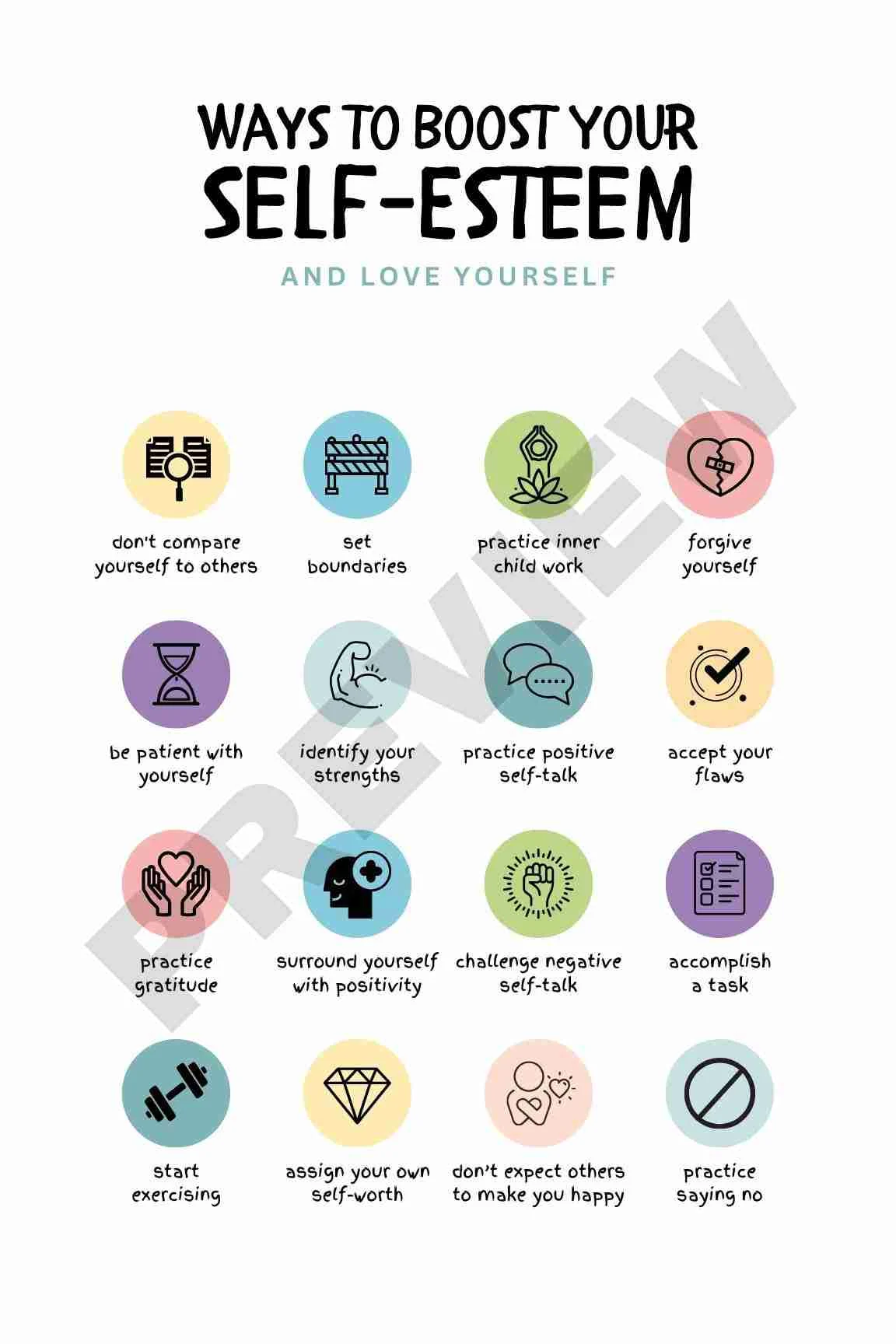

Self-esteem booster exercises are short, repeatable practices that help a person notice their worth and respond to self-criticism with less judgment. The most useful ones are timed, concrete, and evidence-informed: a 5-minute strengths note, a 2-minute self-compassion pause, and a 3-minute values check. They support self-esteem; they do not replace therapy.
- Quick Answer
- Self-Esteem vs. Confidence
- How to Use These Exercises Safely
- The 8 Exercises at a Glance
- Exercise 1: Two-Minute Self-Compassion Pause
- Exercise 2: Five-Minute Strengths Note
- Exercise 3: Reframe the Inner Critic
- Exercise 4: Three-Minute Values Check
- Exercise 5: Gratitude for Yourself
- Exercise 6: Act “As If” for Ten Minutes
- Exercise 7: Evening Self-Reflection Log
- Exercise 8: Weekly Progress Review
- A Sample Seven-Day Plan
- When to Seek Professional Support
- Frequently Asked Questions
- Sources
Quick Answer
Self-esteem booster exercises are short, structured practices that make a person's evaluation of their own worth more concrete. The American Psychological Association (APA) defines self-esteem as how much value a person assigns to themselves; booster exercises turn that evaluation into small, repeatable actions. The table below groups eight timed practices by purpose, duration, and evidence. Each one can be done with a notebook or a notes app, and none requires a download or registration. For the factors that shape that evaluation, see the guide to factors that influence self-esteem.
Self-Esteem vs. Confidence
Self-esteem and confidence are related but not the same. According to the American Psychological Association, self-esteem is a global evaluation of worth, while self-confidence refers to trust in a specific ability or task. A person can feel capable at work and still struggle with low overall self-esteem, or the reverse. Because the exercises below target overall self-worth, they are not quick fixes for performance anxiety. Self-esteem also shifts across life stages; that pattern is covered in self-esteem across the lifespan.
How to Use These Exercises Safely
These exercises are educational tools, not a substitute for therapy or medical advice. If self-criticism feels constant, or if low mood lasts for weeks and interferes with daily life, a licensed mental health professional can help. In the United States, the 988 Suicide & Crisis Lifeline is available by call or text at any time. Choose one or two practices at first, and stop any exercise that makes distress harder to manage.
The 8 Exercises at a Glance
For self-esteem exercises for adults, the eight practices below are grouped by purpose, duration, and the source that supports their premise. In a longitudinal review, Orth and Robins (2014) reported that self-esteem tends to rise from adolescence into midlife, though individual paths vary widely. The evidence column names that source or the APA definition; the individual steps apply the idea in a timed format. Social comparison can also shape the evaluation behind these practices, as covered in self-esteem and social media.
| Exercise | Purpose | Duration | Evidence |
|---|---|---|---|
| Two-Minute Self-Compassion Pause | Respond to self-criticism with warmth instead of judgment | 2 minutes | APA Dictionary (global worth) |
| Five-Minute Strengths Note | Record concrete evidence of strengths instead of vague praise | 5 minutes | APA Dictionary (global worth) |
| Reframe the Inner Critic | Spot, test, and replace an unfair self-judgment | 5 minutes | APA Dictionary (global worth) |
| Three-Minute Values Check | Connect a small action with a chosen value | 3 minutes | APA Dictionary (global worth) |
| Gratitude for Yourself | Appreciate two behaviors of your own | 5 minutes | Orth & Robins (2014) gradual change |
| Act “As If” for Ten Minutes | Practice a confident behavior without waiting to feel confident | 10 minutes | APA Dictionary (global worth) |
| Evening Self-Reflection Log | Close the day with three review questions | 5 minutes | Orth & Robins (2014) |
| Weekly Progress Review | Review one achievement and one adjustment | 5 minutes | Orth & Robins (2014) |
Exercise 1: Two-Minute Self-Compassion Pause
Use this two-minute pause when a mistake triggers sharp self-criticism. It interrupts the spiral by giving the inner voice something more accurate to say. Place a hand on your chest, breathe slowly, and repeat three phrases: “This is hard right now,” “Everyone struggles sometimes,” and “May I respond to myself with the same care I would offer a friend.” Keep the exercise to two minutes. Writing the third phrase may make it feel more concrete.
Exercise 2: Five-Minute Strengths Note
Write three strengths you have shown in the past week. For each one, add one specific example: instead of “I am responsible,” write “I finished the report before the deadline on Thursday.” Specific examples keep the exercise tied to observable events rather than abstract labels. This five-minute note builds on evidence you already have, which can be easier to sustain than repeating general affirmations.
Exercise 3: Reframe the Inner Critic
Identify one self-critical thought, such as “I failed, so I am a failure.” Evaluate it with two questions: “Is this fully true?” and “Would I say this to a friend?” Then replace it with a fair sentence: “I failed that task, but one mistake does not define me.” This three-step sequence—identify, evaluate, replace—is a form of cognitive reframing. Writing it down usually works better than doing it mentally.
Exercise 4: Three-Minute Values Check
Choose three values that matter today, such as honesty, patience, or creativity. Next to each value, write one small action you can take in the next few hours that expresses it. For example, “patience” could become “I will wait before reacting to the email.” Aim for three minutes, not a long moral inventory. Among the self-esteem activities in this list, this one connects self-worth to behavior rather than to a passing feeling.
Exercise 5: Gratitude for Yourself
Name two behaviors of your own that you appreciated today, not fixed qualities. Instead of “I am kind,” write “I listened when my neighbor needed to talk.” This version of gratitude shifts attention from what you have to what you actually did. Spend about five minutes. If nothing comes to mind, start with a small action such as getting out of bed on a difficult morning or completing a simple task.
Exercise 6: Act “As If” for Ten Minutes
Pick one ten-minute task you have been avoiding because you do not feel confident enough. For ten minutes, do it as if you already believed you could handle it: sit at the desk, open the document, answer one email, or make the call. The exercise is behavioral; it does not promise that confidence follows instantly, but it gives self-esteem a concrete experience to work with.
Exercise 7: Evening Self-Reflection Log
At the end of the day, answer three questions in one or two sentences each: “What did I do well today?” “What was difficult?” and “What is one small next step for tomorrow?” Keep the log to five minutes and write only facts, not grades. This evening review turns the day into information rather than a spiral of self-criticism. If a question triggers heavy rumination, skip it and stay with the other two.
Exercise 8: Weekly Progress Review
Once a week, set a five-minute timer and review the previous seven days. Write one win that was directly within your control and one adjustment for the week ahead. The win should be a specific action, such as completing three morning self-compassion pauses. The adjustment should also be small, such as choosing a quieter time for the strengths note. This cadence matches the gradual pattern found in the longitudinal research.
A Sample Seven-Day Plan
Pair two exercises per day. Monday: Two-Minute Self-Compassion Pause and Five-Minute Strengths Note. Tuesday: Reframe the Inner Critic and Evening Self-Reflection Log. Wednesday: Three-Minute Values Check and Act “As If” for Ten Minutes. Thursday: Gratitude for Yourself and Evening Self-Reflection Log. Friday: Strengths Note and Values Check. Saturday: Weekly Progress Review only. Sunday: rest or choose one exercise that felt useful. This plan combines daily confidence-building exercises with lighter days to reduce pressure.
When to Seek Professional Support
These exercises are not a treatment for depression, anxiety, or any clinical condition. If low self-esteem is accompanied by lasting sadness, sleep changes, or thoughts of self-harm, contact a licensed mental health professional. In the United States, the 988 Suicide & Crisis Lifeline is available by call or text 24/7. Persistent difficulty with daily functioning may also appear in the effects of low self-esteem.
Frequently Asked Questions
What exercises boost self-esteem quickly?
The two-minute self-compassion pause and the five-minute strengths note are the fastest to complete. They do not promise an instant change, but they give a person a concrete way to interrupt harsh self-talk and record evidence of worth. A single session is less important than repeating the practice across several weeks.
How long does it take for self-esteem exercises to work?
Research points to gradual change rather than a single turning point. A longitudinal review by Orth and Robins (2014) found that self-esteem often rises from adolescence into midlife, with wide individual variation. That pattern suggests weekly practice matters more than one isolated session.
What is the difference between self-esteem and confidence?
According to the American Psychological Association, self-esteem is a global evaluation of one's worth. Confidence is usually tied to a specific task or ability. A person can feel confident at work and still carry a low overall sense of self-worth, or the reverse.
Can I use these exercises if I am in therapy?
Yes, as informational practice outside sessions, but they do not replace treatment. A person in therapy may share the exercises with a licensed professional, who can adapt them to the treatment plan. If distress increases, pause and discuss it with the provider.
Sources
American Psychological Association. APA Dictionary of Psychology: Self-esteem.
Orth, U., & Robins, R. W. (2014). The Development of Self-Esteem. Current Directions in Psychological Science.
988 Suicide & Crisis Lifeline.
Keep reading