

Self-esteem resources for young women fall into five types: research-based reading, guided workbooks, daily practices, peer support groups, and professional or crisis help. Self-esteem is how a person evaluates their own worth. This guide sorts vetted, mostly free options by type and source, and explains when a licensed professional is the better next step.
- What counts as a good self-esteem resource?
- Where can I read the research on women's self-esteem?
- Self-esteem resources by type: a comparison
- What are good self-esteem workbooks and activities for young women?
- How do social media and body image affect self-esteem?
- When is it time to talk to a professional?
- FAQ
- Sources
What counts as a good self-esteem resource?
A good self-esteem resource is one whose author, source and purpose you can identify, and which describes practice or research without promising results. Self-esteem itself is defined by the APA Dictionary of Psychology as the degree to which a person sees the qualities in their self-concept as positive. Self-concept is the set of beliefs a person holds about who they are. Self-efficacy is the belief in one's ability to handle a specific task, which is why it differs from self-esteem.
Four checks help sort the options:
- Named publisher: a health agency, university, professional body or journal, not an anonymous list.
- No outcome promises: wording such as "research suggests" rather than "guaranteed."
- Clear cost: free, or the price stated before you read further.
- A route to care: a pointer to professional help for symptoms that go beyond everyday self-doubt.
A page that fails the first check is usually the easiest to spot: if you cannot tell who wrote it or when, treat it as opinion. For a fuller definition, see what self-esteem means.
Where can I read the research on women's self-esteem?
The broadest starting point is a 2018 article by Orth, Erol and Luciano in Psychological Bulletin, titled "Development of self-esteem from age 4 to 94 years." Its title states its scope: self-esteem across nearly the whole life course, not only young adulthood. The record is available from the publisher through its DOI link.
Other reliable places to read:
- APA Dictionary of Psychology: short, citable definitions of self-esteem and related terms such as self-concept and self-efficacy.
- NIMH health topics: plain-language pages from the U.S. National Institute of Mental Health, each with a "Last Reviewed" date; its page on caring for your mental health carries April 2026.
- NHS self-help pages: the UK National Health Service publishes a page on raising low self-esteem, with exercises you can do alone.
- University counseling center pages: many publish free handouts; check that the page names the department and a review date.
- PubMed: a free index of peer-reviewed studies, useful when a claim in an article needs a source.
Research on women is often reported inside broader samples, so a result about "adults" may not describe your age group. How self-esteem changes with age covers the main patterns.
Self-esteem resources by type: a comparison
Seven resources, grouped by what they offer, with cost and best use:
| Resource | What it offers | Published by | Cost and access | Best for |
|---|---|---|---|---|
| Caring for Your Mental Health | Self-care tips on exercise, sleep, gratitude and staying connected; guidance on when to seek help (page reviewed April 2026) | NIMH | Free, online | Everyday habits and deciding on next steps |
| How to raise low self-esteem | Written exercises: noting negative beliefs and the evidence against them, listing your positive qualities, setting achievable challenges | NHS | Free, online | A self-guided worksheet-style start |
| Peer support groups | Peer-led groups, in person and online, for people living with depression or bipolar disorder; more than 20,000 meetings a year | DBSA | Free | Sharing experience and coping skills with peers |
| 988 Suicide & Crisis Lifeline | Call, text or chat support, 24/7 | 988 Lifeline | Free and confidential | Moments of crisis or thoughts of suicide |
| Treatment locator | Search for mental health services near you; named by NIMH as the place to start | SAMHSA | Free to search | Finding a licensed provider |
| Lifespan article | Research on self-esteem from age 4 to 94 | Psychological Bulletin (2018) | Publisher access varies | Readers who want the evidence |
| Social media and self-esteem | A 2025 meta-analysis of students; see the social media section below | PLoS One (2025) | Open access | Readers weighing how they use apps |
The first three rows cover everyday needs. Reading and daily practice cost nothing, peer groups and crisis lines are free, and a licensed professional is the only route that usually involves a fee or insurance.
What are good self-esteem workbooks and activities for young women?
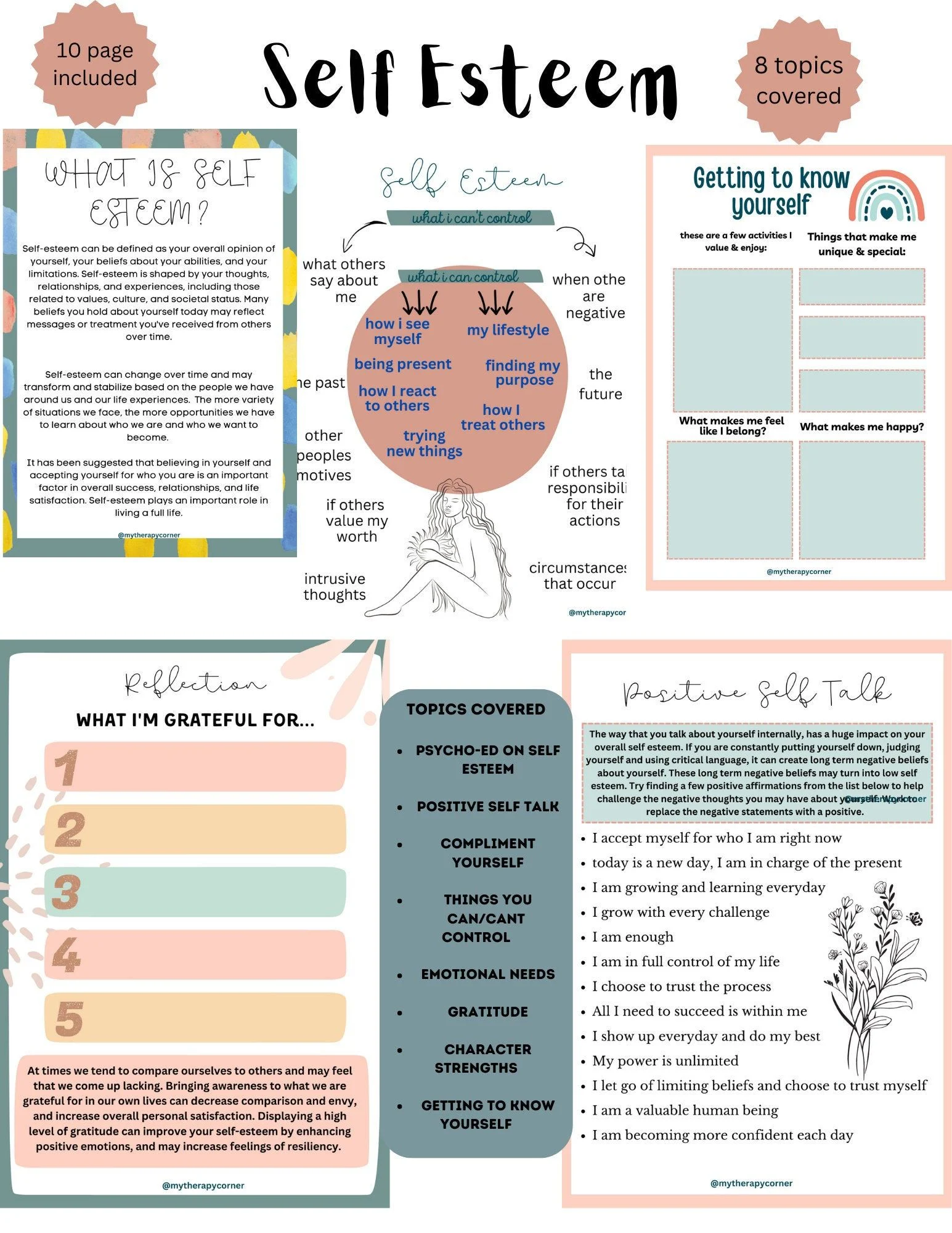
The most dependable self-esteem workbooks are free worksheets from public health services and university counseling centers, which describe exercises without selling a program. If you are searching for a self-esteem workbook for women, look for pages that name the department that wrote them and skip ones that require payment before showing any content. The NHS page is one example: its steps work like a short worksheet.
Its exercises are specific. You notice a negative belief about yourself, write it down, and look for evidence that challenges it. You list your positive qualities and what other people say about you, aiming for at least five items, and keep the list where you can see it. You set achievable challenges, since meeting them can build confidence over time. It also suggests spending more time with supportive people, treating yourself as you would treat a friend, and practising saying no. This is the same idea behind cognitive behavioral approaches: catch a critical thought and write a more balanced version.
Standard questionnaires belong to their publishers and researchers. The Rosenberg Self-Esteem Scale is the best known; look it up through its original source rather than a copy.
For self-esteem activities for young women, NIMH's self-care page lists several that need no materials:
- Practicing gratitude and challenging negative thoughts.
- Keeping a regular sleep schedule.
- Getting regular exercise, even in short bursts.
- Setting priorities and learning to say no when overloaded.
- Staying in touch with friends and family.
These answer the common question of how to build self-esteem as a woman at a practical level: through small, repeated habits rather than one big change. See daily habits and ways to improve self-esteem for step-by-step versions.
Peer groups add something a worksheet cannot. DBSA says its groups are peer-led and are a place to share experiences and discuss coping skills. It also reports research by Pepperdine University on its own groups, which found gains in several areas, self-esteem among them.
Research is mixed on how social media relates to self-esteem, and the strongest recent evidence shows a link rather than a cause. A 2025 meta-analysis in PLoS One pooled studies of students and found a weak negative correlation between self-esteem and social media addiction: a pooled r of −0.24 across 10 articles. Students who reported more addictive use tended to report lower self-esteem. The study's DOI record gives the full methods.
All the underlying studies were cross-sectional, a design that takes one snapshot in time. That means the authors could not tell whether heavy use lowers self-esteem or whether lower self-esteem leads people to use social media more heavily. The finding concerns addictive patterns of use, not every hour spent online.
For readers who notice that scrolling leaves them feeling worse, the practical step that follows from the research on habits is small: change what you follow and when you open the apps, then see how you feel. Social media and self-esteem goes through the evidence in more detail.
When is it time to talk to a professional?
It is time to talk to a licensed professional when distressing symptoms last two weeks or more, according to NIMH. Examples it lists include trouble sleeping, changes in appetite, low mood that affects daily routines, poor concentration, loss of interest and irritability. The NHS page makes a similar point: if self-help steps are not enough, talking therapies such as counselling or cognitive behavioural therapy can help.
A practical sequence for many people:
- Talk to a primary care provider, who can rule out physical causes and refer you onward.
- Use the SAMHSA treatment locator, linked in the table, to find services nearby.
- Call or text 988, or chat online, if you are struggling or having thoughts of suicide; the service is free, confidential and open 24/7.
- Call 911 in a life-threatening emergency.
Persistent low self-esteem can accompany other difficulties; the effects of low self-esteem are worth reading if you are unsure where the line sits.
FAQ
What is self-esteem?
Self-esteem is how a person evaluates their own worth. It differs from confidence, which is usually tied to a specific task.
Are free self-esteem resources reliable?
Many are, when they come from NIMH, universities, public health services or peer-reviewed journals. Check for a named publisher, a review date and the absence of outcome promises.
Can a workbook replace therapy?
No. A workbook can support practice, but it does not treat mental health conditions. If low mood or anxiety lasts two weeks or more, consider talking to a licensed professional.
What if low self-esteem comes with persistent low mood?
Speak with a licensed professional, starting with a primary care provider if that is easier. If you are in crisis, call or text 988.
Sources
- National Institute of Mental Health, "Caring for Your Mental Health" (reviewed April 2026)
- NHS, "How to raise low self-esteem"
- 988 Suicide & Crisis Lifeline
- American Psychological Association, APA Dictionary of Psychology, entry "self-esteem"
- Orth, U., Erol, R. Y., & Luciano, E. C. (2018). Psychological Bulletin
- Jing, Z., et al. (2025). PLoS One, meta-analysis of social media addiction and self-esteem among students
- Depression and Bipolar Support Alliance, support groups
- SAMHSA, FindTreatment.gov
This guide is for general information and is not medical advice; in the U.S., call or text 988 if you are in crisis.
Keep reading