
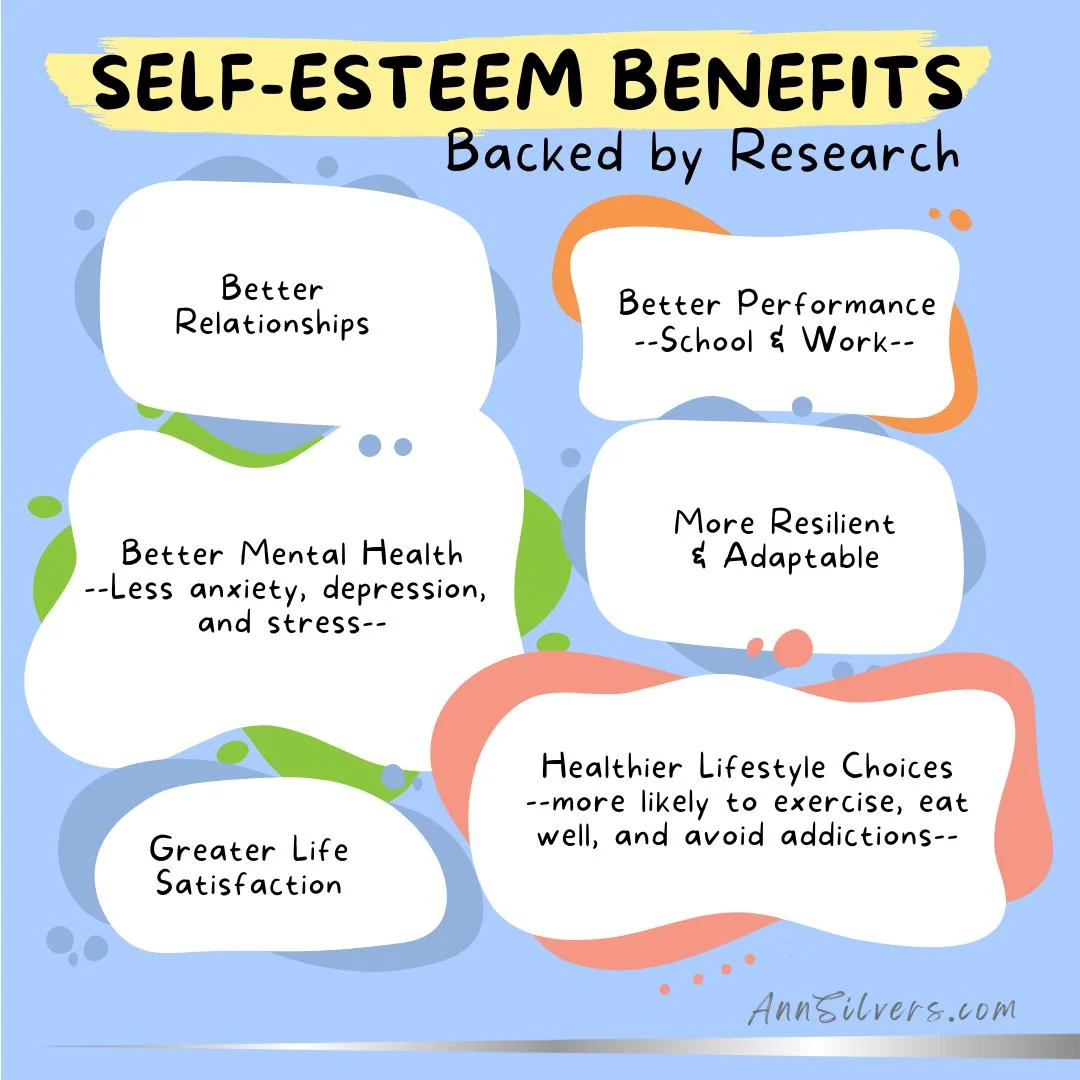

Self-esteem research examines how people evaluate their own worth, how that evaluation changes over a lifetime, and what it predicts. Longitudinal studies suggest self-esteem and social relationships influence each other over time, while a major review found little evidence that raising self-esteem alone improves grades or behavior. Most findings are correlational, not proof of cause.
What counts as self-esteem research?
Self-esteem research is the study of how people judge their own value and how that judgment relates to other parts of life. Most of it comes from personality and social psychology, with contributions from education and developmental science. For a plain definition of the basic idea, see what self-esteem means.
Three terms are easy to mix up. Self-esteem is the overall sense of one's own worth. Self-concept is the broader set of beliefs a person holds about who they are. Self-efficacy is confidence in handling a specific task, which is why someone can feel capable at work and still feel low self-worth.
Researchers usually measure self-esteem with short self-report questionnaires. The best known is the Rosenberg Self-Esteem Scale, introduced by sociologist Morris Rosenberg in Society and the Adolescent Self-Image (Princeton University Press, 1965). It asks people to rate how far a handful of statements about themselves apply, and the answers are combined into one score. Because it relies on self-report, it captures how people see themselves, not how others see them.
Which studies shaped the field?
Four works come up again and again in textbooks and news coverage. Together they cover how self-esteem is measured, how people compare themselves with others, what high self-esteem does and does not do, and how self-esteem and relationships interact.
| Study | Design | What it found | Limit | Link |
|---|---|---|---|---|
| Rosenberg (1965), Society and the Adolescent Self-Image | Survey of adolescents; introduced the Rosenberg scale | Gave the field a short, widely reused way to measure global self-worth | Self-report; a snapshot of one group in one era | Princeton University Press (book) |
| Festinger (1954), "A theory of social comparison processes," Human Relations 7(2):117–140 | Theoretical paper | People evaluate their abilities and opinions by comparing themselves with others when no objective standard exists | A theory, not a test; written long before social media | DOI |
| Baumeister, Campbell, Krueger & Vohs (2003), Psychological Science in the Public Interest 4(1):1–44 | Review of the existing literature | Benefits of high self-esteem are mainly greater initiative and pleasant feelings; no evidence that boosting self-esteem itself produces benefits | Many reviewed studies were correlational | DOI |
| Harris & Orth (2020), Journal of Personality and Social Psychology 119(6):1459–1477 | Meta-analysis of longitudinal studies | Self-esteem and social relationships influence each other over time | Averages across studies; individual paths differ | DOI |
The Baumeister review matters most for readers who want to know whether self-esteem programs work. The authors concluded that school grades correlate only modestly with self-esteem, and that good performance partly produces self-esteem rather than the reverse. They also cautioned that indiscriminate praise can encourage narcissism, and suggested tying praise to effort and improvement instead.
What topics does self-esteem research cover?
The field spreads across several recurring themes, and each one has its own body of studies. Anyone browsing self-esteem research topics for a paper or class will meet these six most often.
Relationships
The most direct evidence comes from Harris and Orth's 2020 meta-analysis, which pooled longitudinal studies that followed the same people over time. It points in both directions: better relationships are linked to later gains in self-esteem, and higher self-esteem is linked to later gains in relationships. Because the data are averages, they describe a general pattern, not what will happen to any one person.
Social media and social comparison
Festinger's 1954 theory predicts that people compare themselves with others, especially similar others, to judge how they are doing. Researchers later applied that idea to online feeds, where comparison material is constant. Findings there are more mixed than headlines suggest; the post on social media and self-esteem covers that evidence in detail.
School and students
Studies of students ask whether self-esteem predicts grades, and the answer is a modest correlation without clear causation. Baumeister and colleagues found that programs aimed at raising self-esteem had not improved academic results. A research paper on the effects of low self-esteem in students should therefore separate what low self-esteem accompanies from what it causes; the overview of the effects of low self-esteem lays out that distinction.
Factors affecting self-esteem
Research on what shapes self-esteem looks at family, peers, school experiences, and personal achievements. Most designs can show association but not isolate one cause. Readers collecting sources on factors affecting self-esteem can start with the factors that influence self-esteem.
Life span
Large longitudinal projects track how self-esteem moves from childhood through old age. Patterns differ between people and between studies, so exact numbers by age belong in the post on how self-esteem changes with age, where each figure is tied to its source.
Psychological frameworks
Theories explain why self-esteem might matter: as a gauge of social acceptance, as a buffer against threat, or as a by-product of competence. These frameworks, and the debates between them, are summarized in the psychological theories of self-esteem.
Does low self-esteem cause problems? What the older research got wrong
Low self-esteem is associated with some difficulties, but the evidence does not show that it causes them. Much writing from around 1990 treated low self-esteem as a root cause of violence, teenage pregnancy, drug use, and suicide. Later reviews found that those claims rested largely on correlations.
Baumeister and colleagues concluded that neither high nor low self-esteem directly causes violence, and that high self-esteem does not prevent smoking, drinking, drug use, or early sexual activity. A third factor, such as family conflict or poverty, can plausibly shape both self-esteem and the outcome. Research is mixed on how much any of these links survive once such factors are controlled.
That does not make how a person feels about themselves unimportant. If low mood lasts for weeks or interferes with daily life, a licensed mental health professional can help. In the U.S., the 988 Lifeline is available by call or text at any hour.
How can you read a self-esteem paper?
A paper's design tells you how much weight its claim can carry. These five checks help with that:
- Sample. Who was studied (age, country, size), and does that match the group the headline talks about?
- Design. A longitudinal study follows the same people over time; a cross-sectional study compares different people at one moment, so it cannot show change.
- Measure. Was self-esteem rated by the participants themselves, as on the Rosenberg scale, or by someone else?
- Effect size. A result can be statistically significant and still be small in everyday terms.
- Correlation or cause? Look for whether the authors claim only an association, or whether the design (for example, a randomized experiment) can support a causal claim.
Frequently asked questions
What is self-esteem research about?
It studies how people evaluate their own worth, how that evaluation changes across life, and what it is linked to, such as relationships, school performance, and well-being. Most studies are observational.
Does high self-esteem cause success?
Not clearly. A 2003 review by Baumeister and colleagues found that high self-esteem is tied mainly to initiative and pleasant feelings, and it found no evidence that raising self-esteem alone improves grades or job performance.
What are the main factors that affect self-esteem?
Research points to relationships, social comparison, and experiences at home and school. Studies usually show association rather than a single cause.
How is self-esteem measured?
Mostly with self-report questionnaires. The Rosenberg Self-Esteem Scale is the most widely used: people rate short statements about themselves, and the ratings are combined into one score.
Sources
- Baumeister, R. F., Campbell, J. D., Krueger, J. I., & Vohs, K. D. (2003). Psychological Science in the Public Interest, 4(1), 1–44.
- Festinger, L. (1954). A theory of social comparison processes. Human Relations, 7(2), 117–140.
- Harris, M. A., & Orth, U. (2020). The link between self-esteem and social relationships: A meta-analysis of longitudinal studies. Journal of Personality and Social Psychology, 119(6), 1459–1477.
- Rosenberg, M. (1965). Society and the Adolescent Self-Image. Princeton University Press.
This page is for general information and is not medical or mental health advice.
Keep reading