
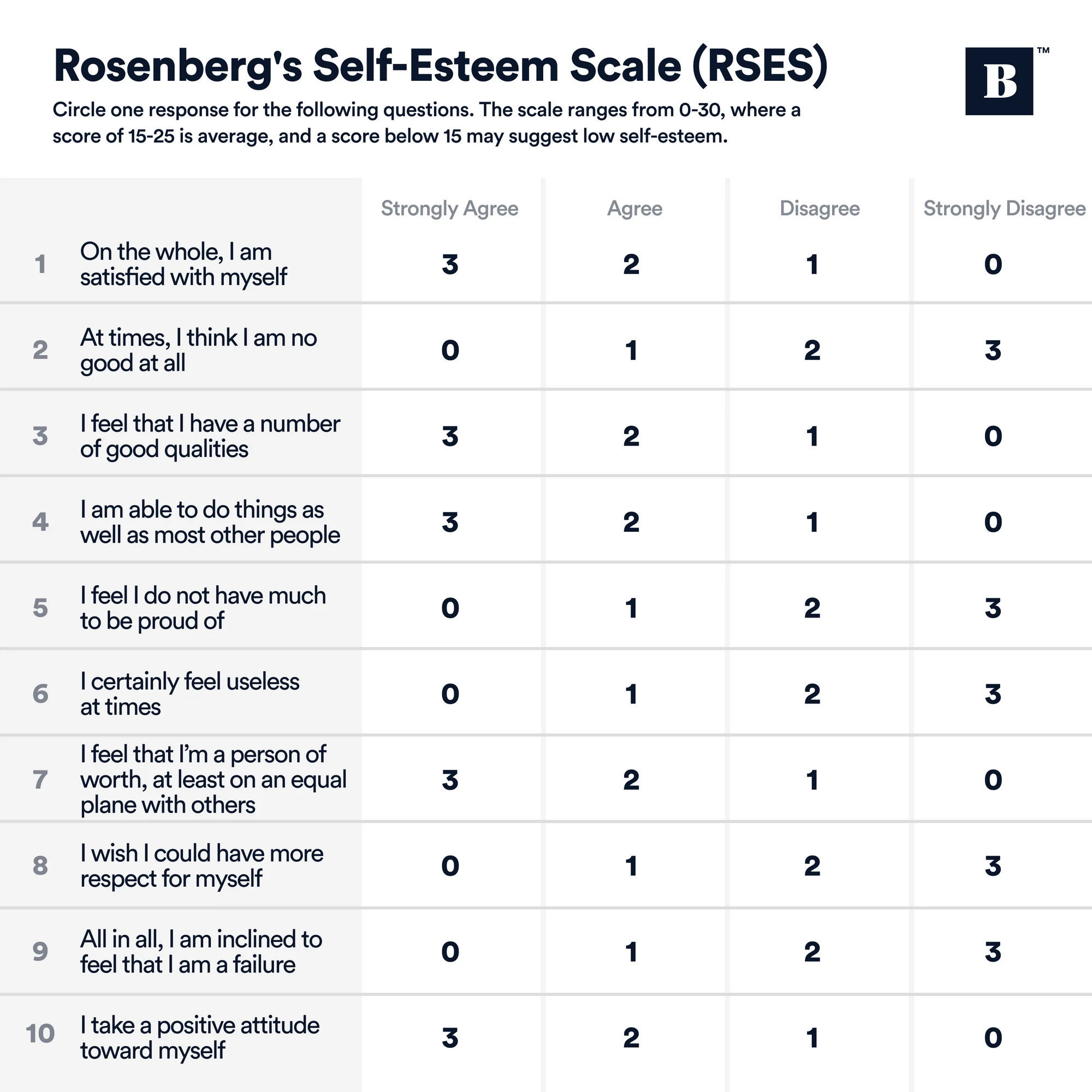

A self-esteem test is a questionnaire that estimates how favorably a person evaluates their own worth. A widely used example is the Rosenberg Self-Esteem Scale, a 10-item survey published in 1965. It gives a score for research and self-reflection, not a diagnosis, and results can shift with mood, context, and honesty.
- What does a self-esteem test measure?
- How does the Rosenberg Self-Esteem Scale work?
- How does the Rosenberg scale compare with other self-esteem tests?
- Is the Rosenberg self-esteem test reliable and valid?
- What can a self-esteem test not tell you?
- What do your results mean, and when should you talk to someone?
- Where can you find the original scale?
- FAQ
- Sources
What does a self-esteem test measure?
A self-esteem test measures global self-esteem: the overall way you judge your own worth, rather than how you feel about one skill or one day. Self-esteem is related to, but different from, self-concept (the beliefs you hold about who you are) and self-efficacy (your confidence that you can handle a specific task).
Most tests ask you to rate statements about yourself and add the answers into a single score. That number summarizes how you answered at that moment. It is not a clinical measure, and no questionnaire of this kind can diagnose a condition.
Where those answers come from is a separate question, covered in our look at what shapes self-esteem.
How does the Rosenberg Self-Esteem Scale work?
The Rosenberg Self-Esteem Scale asks you to respond to 10 statements about your overall view of yourself, then adds the answers into one total. A higher total means a more favorable self-evaluation.
The scale comes from sociologist Morris Rosenberg's 1965 book Society and the Adolescent Self-Image, published by Princeton University Press, which drew on research with adolescents. Its format is simple:
- Ten statements. Five are worded positively and five negatively.
- Four answer options. Respondents choose on a Likert scale from "strongly agree" to "strongly disagree."
- Reverse scoring. The negatively worded statements are scored in the opposite direction, so that a higher number always points the same way.
- One summed score. Scoring adds the ten values together.
The mix of positive and negative wording is deliberate. It discourages people from agreeing with everything automatically, which would otherwise inflate scores.
Sources differ on where to draw lines between "lower" and "higher" totals, and those lines are conventions rather than clinical thresholds. A single total says little on its own; comparing your own answers over time says more.
How does the Rosenberg scale compare with other self-esteem tests?
The Rosenberg scale is a short measure of global self-esteem, while other instruments cover several life areas or only how you feel in the moment, as the table shows.
| Test | What it measures | Trait or state |
|---|---|---|
| Rosenberg Self-Esteem Scale (10 items) | Global self-worth | Trait-like (general level) |
| Coopersmith Self-Esteem Inventories | Self-esteem across several life areas | Trait-like (general level) |
| State Self-Esteem Scale | Momentary feelings of self-worth | State (changes by situation) |
A trait measure asks how you generally see yourself. A state measure asks how you feel right now, so it can move after a good or bad day. Choosing between them depends on the question being asked: a researcher tracking a person's long-term level will favor a trait scale, while one studying the effect of a specific event may prefer a state scale.
Is the Rosenberg self-esteem test reliable and valid?
Research suggests the Rosenberg scale is a dependable measure of global self-esteem in adults, though it remains a self-report tool. Reliability means it gives consistent results; validity means it measures what it claims to.
One widely cited check is a 2001 paper by Richard Robins, Holly Hendin, and Kali Trzesniewski in Personality and Social Psychology Bulletin (27(2), 151–161), titled "Measuring Global Self-Esteem." The authors compared the Rosenberg scale with a single-item question about overall self-esteem across several studies. In three studies with adults, the two measures agreed strongly and related to other characteristics in nearly the same way.
The takeaway is that a short, well-built measure can capture much of what a longer one does, which is part of why the 10-item Rosenberg scale is so widely used.
What can a self-esteem test not tell you?
A self-esteem test cannot tell you why you feel the way you do, whether anything is wrong, or what your score will be next year. Its main limits are these:
- It relies on self-report. You may rate yourself differently depending on your mood that day, how closely you read each statement, or how much you want to be seen favorably.
- Social desirability. Some people choose the answer that sounds better rather than the one that feels true, even when no one else will see it.
- State versus trait. A score may reflect a rough week rather than your general level.
- Change over time. In a 2014 review in Current Directions in Psychological Science (23(5), 381–387), Ulrich Orth and Richard Robins report that self-esteem tends to rise from adolescence to middle adulthood, peak around ages 50 to 60, and then decline. A score at 17 and one at 57 are therefore not directly comparable.
- No context. The number says nothing about relationships, health, or circumstances.
Individual paths vary widely, and the pattern above describes group averages. More on this in how self-esteem changes with age.
What do your results mean, and when should you talk to someone?
A result is a snapshot, not a verdict. Taking the same scale again in a few months, on a different kind of day, can give a different number, and that difference is normal.
If low mood lasts for weeks or interferes with sleep, work, school, or relationships, a licensed mental health professional can help. In the U.S., the 988 Suicide & Crisis Lifeline offers free, private support by call, text, or chat, 24 hours a day, every day of the year. It is open to anyone in emotional distress, not only in an emergency.
For general reading, see these ways to build self-esteem and a set of everyday habits that people use to support how they see themselves.
Where can you find the original scale?
The original scale and its scoring instructions come from the author's own publications and from academic repositories that host it with permission. The primary source is Rosenberg's 1965 book from Princeton University Press, so check the publisher or your library for the current edition.
FAQ
What is a good score on the Rosenberg Self-Esteem Scale?
A higher total means a more favorable view of oneself, but there is no single "good" score. Published sources disagree on cutoffs, and a number alone is not a diagnosis. Looking at how your own answers change over time is more informative than comparing yourself with a fixed line.
Is the Rosenberg self-esteem test accurate?
It is a widely used measure of global self-esteem, and validation studies, including the 2001 Robins, Hendin, and Trzesniewski paper, support its use with adults. It is still a self-report, so mood and honesty can affect results.
Is there a self-esteem test for adults?
Yes. Although the Rosenberg scale was first developed with adolescents, researchers also use it with adults. The State Self-Esteem Scale, by contrast, measures how you feel at a given moment.
Can an online self-esteem test diagnose anything?
No. An online test can help you reflect on how you see yourself, but it cannot diagnose a condition. If your result or your mood worries you, a licensed professional can offer a proper assessment.
Sources
- Robins, R. W., Hendin, H. M., & Trzesniewski, K. H. (2001). Measuring Global Self-Esteem: Construct Validation of a Single-Item Measure and the Rosenberg Self-Esteem Scale. Personality and Social Psychology Bulletin, 27(2), 151–161.
- Orth, U., & Robins, R. W. (2014). The Development of Self-Esteem. Current Directions in Psychological Science, 23(5), 381–387.
- Rosenberg, M. (1965). Society and the Adolescent Self-Image. Princeton University Press.
- 988 Suicide & Crisis Lifeline, as linked above.
This information is general and is not medical or psychological advice.
Keep reading